Published September 9, 2026
Manual vs AI Islamic Lecture Transcription: What Still Needs Human Review?
A practical comparison of manual and AI lecture transcription, including which tasks can be accelerated and which Quran, Hadith, Arabic, and contextual details still need people.
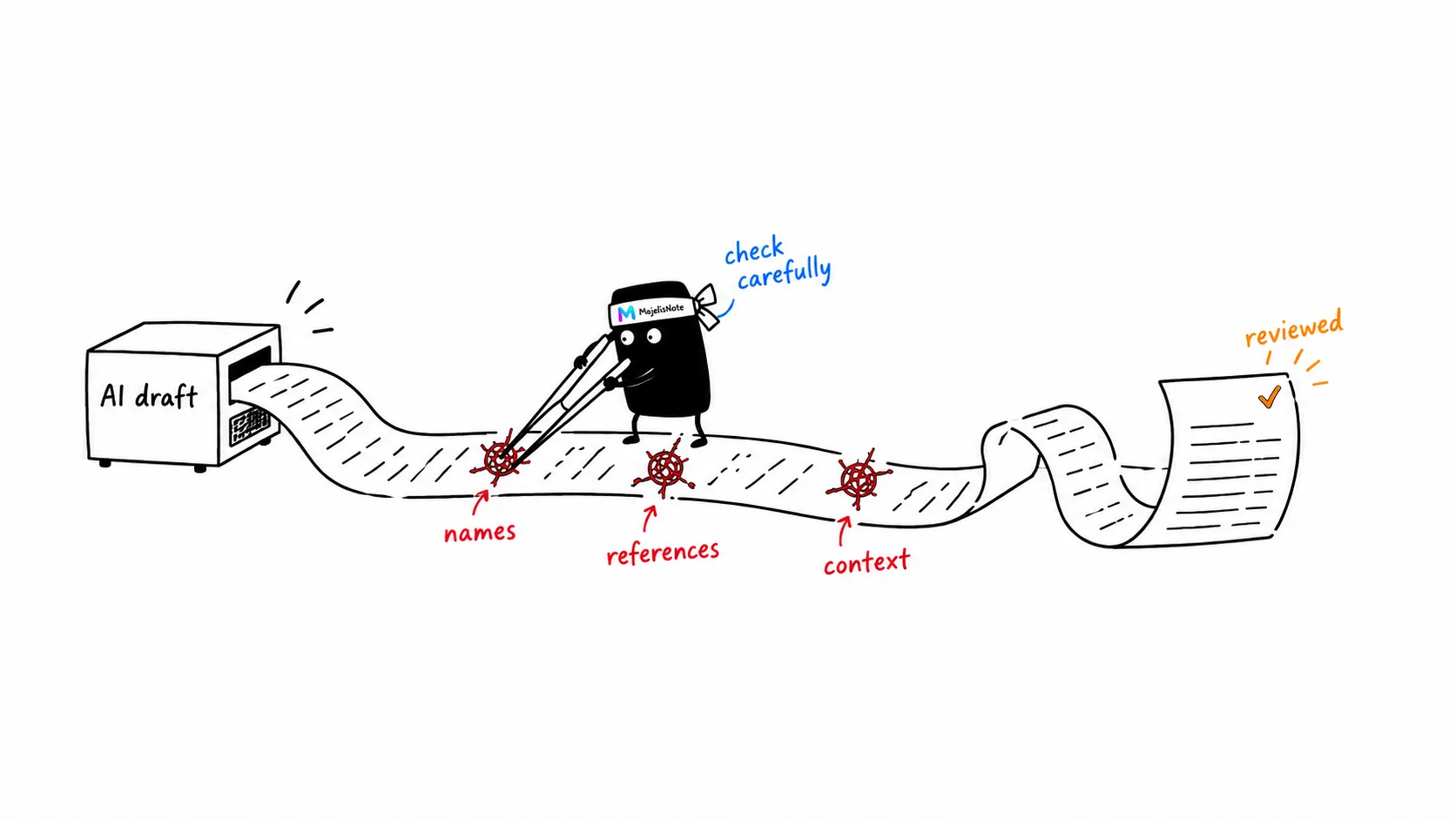
A volunteer receives a two-hour Islamic lecture recording on Sunday evening. Manual transcription could occupy several nights. Publishing the untouched AI output could send a mistaken book title or mismatched verse to hundreds of readers.
The sensible choice is not purely manual or purely automated. Use AI for mechanical work, then put human review where an error would have the greatest consequence.
What AI should handle
AI is effective at producing a first draft, dividing a recording by time, and making speech searchable. An administrator no longer needs to replay two hours of audio merely to locate one discussion.
An AI Islamic lecture transcription workflow can also help separate speakers, handle language switching, structure summaries, and surface possible references. These capabilities reduce repetitive work. They do not give scholarly authority to the output.
The strongest advantage appears before publication. An automated draft gives the editor something concrete to review. Timestamps make a doubtful sentence easy to compare with the audio. Text search finds every mention of a name or subject within the session.
What people must still decide
Check Quran verses and Hadith against trustworthy sources. A similar-sounding passage is not necessarily the reference intended by the ustadz. Chain, grading, narration number, and explanatory context should not be inferred from a text match alone.
Arabic terminology also needs attention. A single letter can change a word. Book and scholar names are often absent from general-purpose vocabularies. If the material will become a handout or public article, ask someone familiar with the subject to review those passages.
People also decide what deserves to be summarized. A system can extract apparent key points, but an editor knows whether an answer applies only to a specific question, whether an aside should be omitted, or whether a statement requires its preceding paragraph to avoid misleading readers.
A realistic workflow for a small team
Let AI create the complete transcript. An editor then checks terminology, names, numbers, speaker changes, and every reference intended for publication. Build the summary from that reviewed version, not from the raw draft.
Keep timestamps connected to the original recording. If the ustadz or a reader provides a correction, the editor can return to the exact moment and update the text without repeating the entire process.
An internal archive may be acceptable with a visible “draft” label. Public da’wah material needs a higher review standard. AI speed is valuable because the team gains more time for validation, not because validation disappears.