Published June 29, 2026
Live Transcription: Capturing Knowledge as the Lecture Unfolds
What it feels like when the Islamic lecture is still happening and the transcript is already written — and why that changes everything for the person who usually has to do it afterward.
Bismillah,
Most transcription workflows start after the Islamic lecture ends. Record first, process the transcript afterward.
After the session, someone has to sit with the recording from the beginning: replay, type, stop when the ustadz switches to Arabic, open the verse to verify the citation, clean up the formatting into something readable. That is the work. And in almost every team, that work falls to one person.
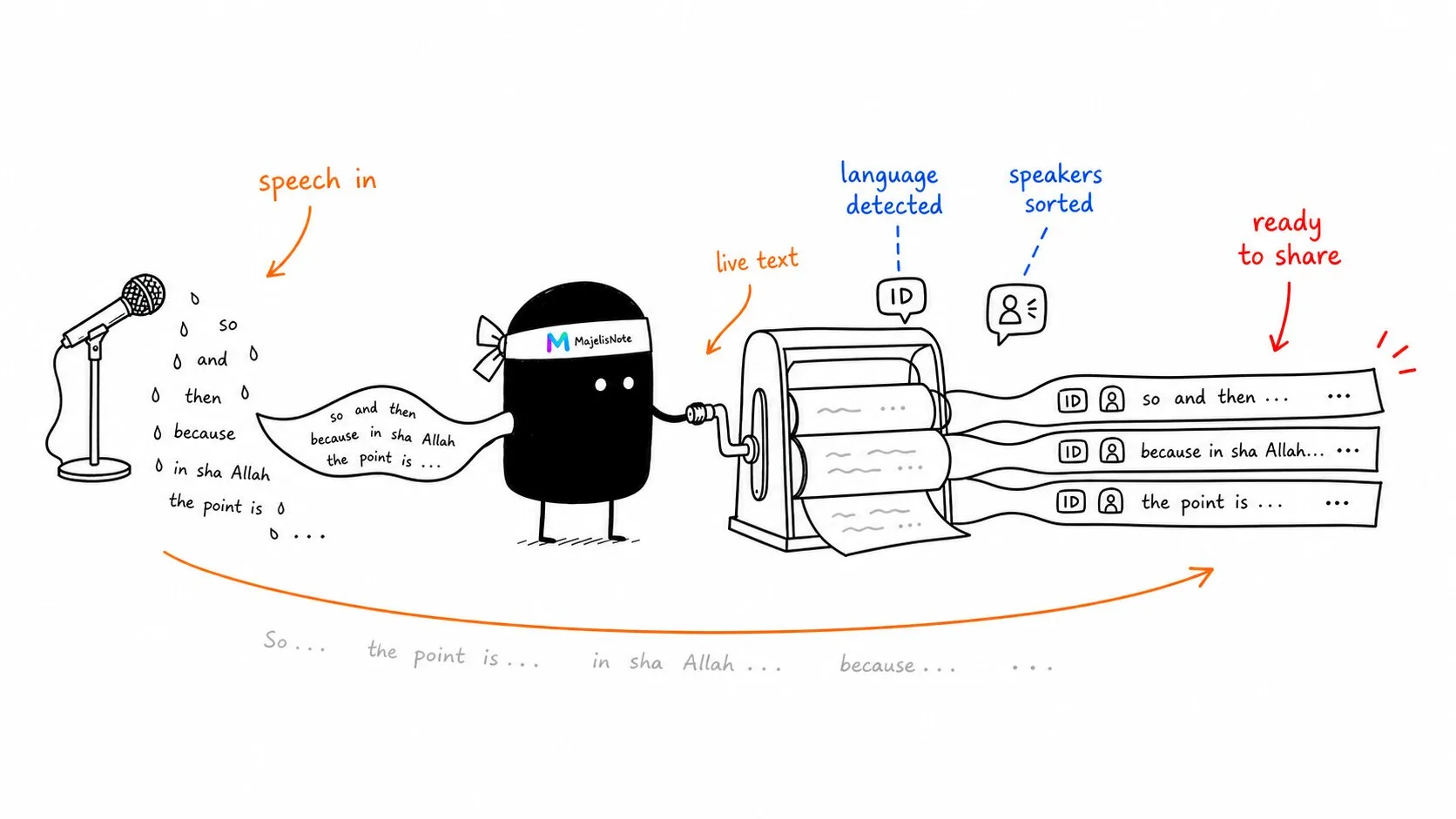
Live transcription flips this order. Text appears as the ustadz speaks. Once the session ends, the transcript is already there. The ustadz is still speaking. Quoting a verse in Arabic, translating it, then continuing the explanation — all captured.
Most teams have recordings waiting for weeks. Not because the team is slow, but because the work can only start after the Islamic lecture ends — after getting home.
When a session opens with MajelisNote, live transcription runs. Words appear as speech is recognized. Sentences that are fully processed show in clear dark text. Words still being worked out show lighter — the system listening before it commits to a line.
When the Ustadz Switches Languages
In an Islamic lecture, language shifts happen without announcement. A verse arrives in Arabic. The Indonesian translation follows immediately. The explanation continues, sometimes drifting into the regional language depending on the room. For anyone transcribing by hand, the Arabic segments are the hardest — not because they are long, but because a single quoted ayah requires a separate step: identify the verse, find the source, write it out correctly. One citation can add twenty minutes to a transcription session.
Live transcription handles this in the moment. Each language is detected and labeled automatically — no manual tagging required. Arabic, Indonesian, Malay, and English are all recognized, and the transcript reads clearly even when several of them appear inside a single paragraph.
The Q&A, and Going Home Without the Task
The most-cited part of any Islamic lecture is rarely the prepared lecture. It is usually a moment from the Q&A — a specific question from the floor that drew out an answer sharper than anything in the scripted material. That is what people screenshot most, quote in group chats, and return to a month later. It is also the part most likely to disappear. Multiple voices, no timestamps, easy to mishear.
When the session ends, the transcript saves automatically to the dashboard. Nothing to upload, nothing to process. The team’s work is done during the Islamic lecture — what remains is validation from notes that already exist.
If you have a session coming up, open MajelisNote and press start before the ustadz begins.
For recordings already in your archive, follow the Islamic lecture transcription guide to make them searchable.